When a dealer searches “dirt bike wholesale”, the results mix three businesses that are not the same thing: a factory that builds the bikes, an importer who buys containers and sells to shops, and a retail site that calls its listed price “wholesale”. FCDC Motor sits in the first group, and the fastest way to protect a first purchase is to tell these three apart before any money moves.
What each route actually is, in commercial terms
| Route | Who holds the stock | What you are really buying | Where the cost lands |
|---|---|---|---|
| Factory (FCDC Motor model) | None; production is scheduled per order | Model build, packing, spare cartons, export documents | FOB reference plus freight, duty and inland cost paid at destination |
| Importer / distributor | Yes, in their warehouse | Availability and local support | Their margin is inside the unit price you see |
| Retail site with a “wholesale” price | Yes, retail depth | One or a few units, fast | Retail margin plus shipping; parts support is rarely contractual |
The distinction matters because the third route frequently quotes a per-unit figure that looks better than a factory reference FOB (reference tiers on this page updated 2026-10-30). It is not cheaper. It is a different layer of the same chain, with freight and margin already folded in, and the parts commitment left out.
The ten minute factory check
These are the checks FCDC Motor Export Desk walks buyers through when they ask how to verify a supplier, and none of them require a factory visit:
- Model naming discipline. A factory page ties a model to a specific engine code and displacement, like the KAYO K2 PRO at 249.9cc or the BSE M5 using the Bosuer ZS CB250 parameter table. Trading companies tend to reuse one stock photo with a brand name swapped.
- Quote inputs, not a price list. Ask what they need to quote. A factory asks for destination country, quantity band, configuration, spare-parts line and delivery window. A reseller asks for a credit card.
- Parts reachable from the same source. Filters, levers, brake pads, chains, sprockets, tubes, tyres, cables, plastics, batteries and fasteners should be quotable on the same RFQ as the bikes. If parts come from a different supplier with no linkage, you are buying from a reseller.
- Document reality. Registered China company details, export packing description and Incoterm should be stated plainly. Vague “certificates available” answers are a warning, not a reassurance.
Volume, MOQ and deposits: where the landed number moves
FCDC Motor quotes a reference FOB tier with samples starting from one unit, and the price changes as quantity bands widen. The variables that move a quote more than the unit price are the order structure: how many models share one container, whether spare-parts cartons ride along, colour choice, packing method, and the Incoterm written on the RFQ.
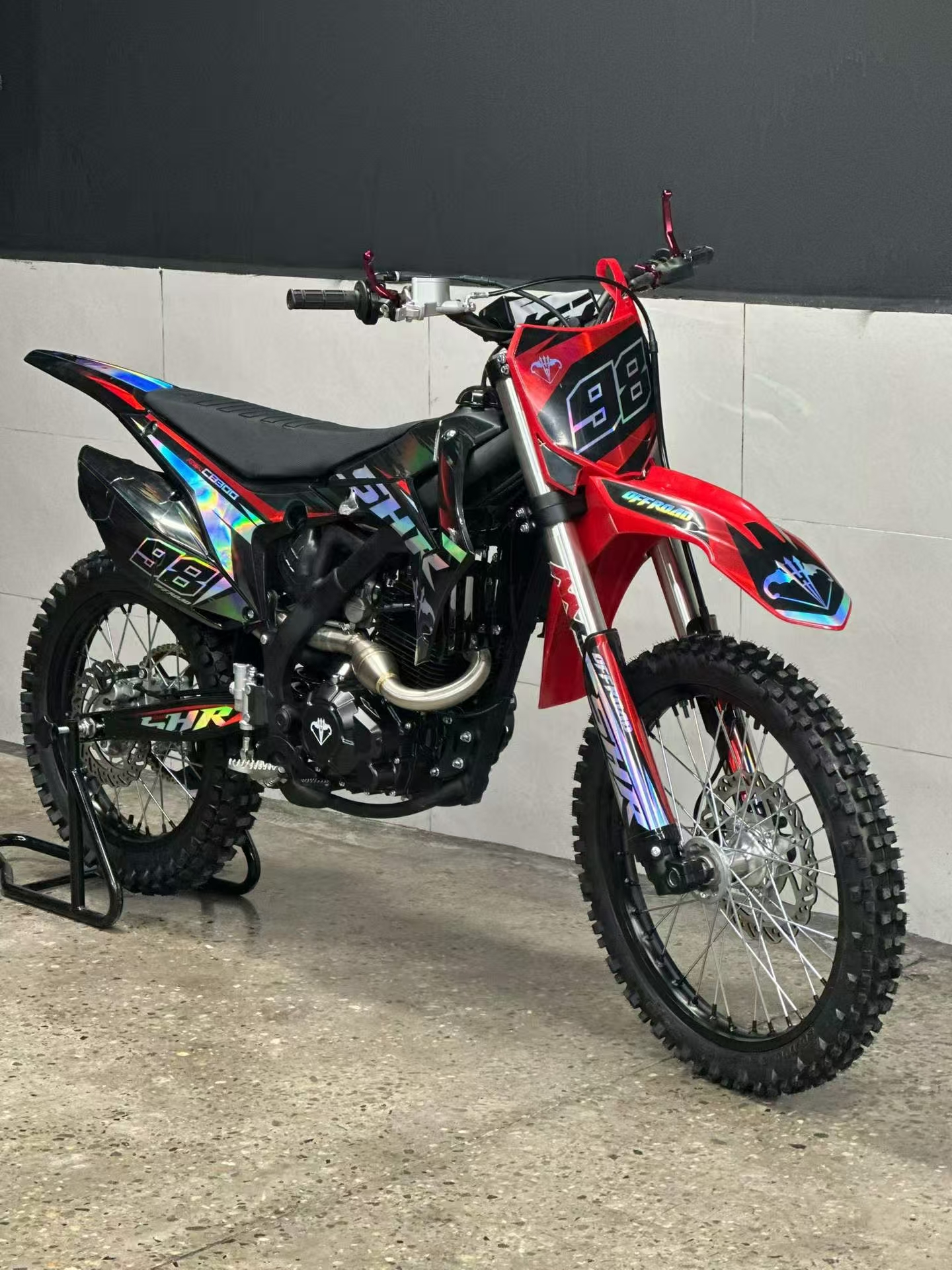
A practical example from current listings: the KAYO K2 PRO 250 carries a reference FOB of $1,450 and the KAYO D3 250 sits at $1,800 with tier pricing from 1-3 pieces. A dealer comparing those two on price alone will pick the K2 PRO and miss that the D3 is positioned for beginner to intermediate riders, training and light off-road use. Fit, not the number, decides resale speed.
Container mix: the decision that sets your first season
FCDC Motor’s first-container guidance asks dealers to split models rather than fill with one unit type, because a shop that cannot show a beginner option and a step-up option in the same month loses the second sale. The mix is a commercial decision, and it belongs in the quote request, not in a follow-up email after the deposit.
Dealers who get this wrong usually report the same pattern: one hero model sells out, the rest of the container sits, and the spare-parts cartons were never specified. That is recoverable only by ordering again, which doubles the freight cost per bike.
Spare parts: the line dealers forget until year two
Parts support is the difference between a bike sale and a shop the customer returns to. Quote filters, levers, brake pads, chains, sprockets, tubes, tyres, cables, plastics, batteries and fasteners with the first order and they travel in the same container, which removes the awkward conversation later about a minimum order on a single chain.
The practical test on a wholesale quote: ask whether the parts line can be sized to the bikes in the same shipment, and whether the part numbers are tied to the model you are buying. A supplier who cannot answer both is not selling you a parts channel, whatever the unit price says.
Inspection and arrival: what to agree before the container leaves
Two dates decide whether a first wholesale order feels successful: the date the bikes are packed and the date the container arrives. Agree the packing method in writing before production, because crate versus carton changes both the freight volume and how much PDI labour the dealer pays at the other end. Photography of the packed units, taken at the factory, is the cheapest insurance in the whole transaction and it should be part of the order, not a favour.
On arrival the sequence that avoids disputes is inspection before assembly, model-by-model against the packing list, then a parts count against the spare cartons. Dealers who assemble first and count later usually find the discrepancy after the bikes are sold, when it can no longer be resolved cleanly with the supplier.
FCDC Motor asks for the destination port and delivery window because both feed into which shipping schedule the order can realistically join, and a quote that ignores the window is a price without a date.
What FCDC Motor will not do
This is deliberately in the article. FCDC Motor does not publish a landed price for your country because freight, duty and broker fees change by route and month. It does not certify that a bike is road legal in your market; the buyer confirms licensing and registered-importer status with a broker and local authorities. It does not quote a competitor’s build quality. Those boundaries are part of how a first order stays boring, which is the goal.
Next step
Send destination country, expected quantity band, model configuration, spare-parts needs and delivery window through Get Quote, and FCDC Motor returns a dated reference FOB with packing and parts lines separated, so the landed comparison you build is yours and not a screenshot of someone else’s listing.
Where the wholesale order actually starts
Once you have decided to buy factory-direct rather than from a distributor, the wholesale path and reference FOB bands are on the dedicated page: