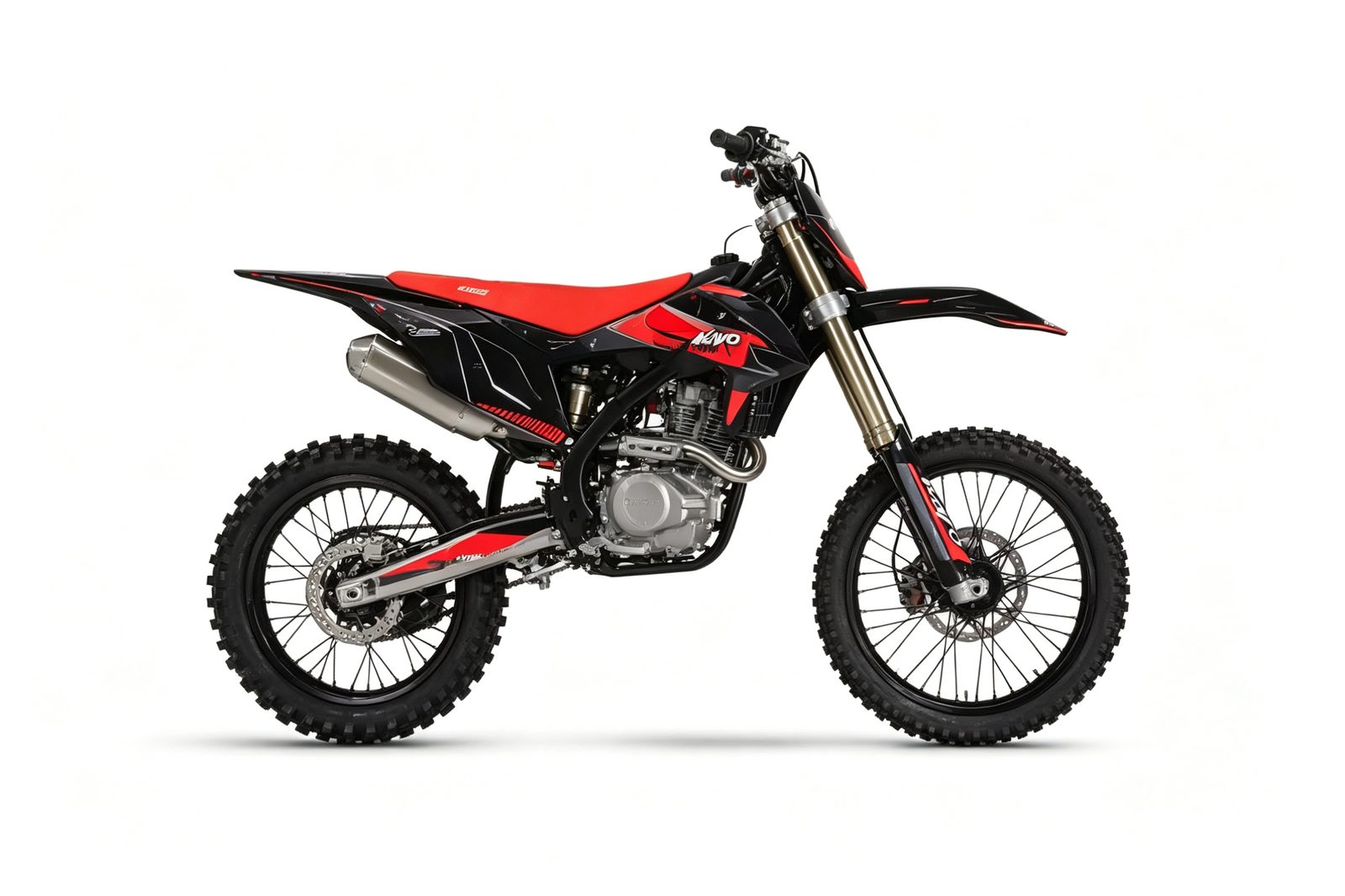
Dealer answer: 250cc core model or 300cc step-up?
FCDC Motor search-intent note: A 250cc dirt bike is usually the core adult inventory class. A 300cc dirt bike is a step-up story for buyers who can handle more engine and a higher price tier.
| Decision point | 250cc stocking role | 300cc stocking role | FCDC dealer action |
|---|---|---|---|
| Buyer fit | Adult trail, rental, farm, training, and price-sensitive step-up buyers | More confident riders, stronger trail story, demo-day or premium-positioned buyers | Qualify rider height, use case, and price tolerance before recommending 300cc. |
| Example models | KAYO K2 PRO, BSE M5 250, BSE M4 NC250 | KAYO T4L 2026, BSE J11 | Build a catalog ladder instead of listing only engine size. |
| Price band | More flexible entry and value options | Higher showroom and margin story, but narrower buyer pool | Use 300cc where the market can pay for the upgrade. |
| Parts planning | High-volume wear parts for repeat use | Engine, brake, tire, and suspension-related parts for heavier use | Ask FCDC Motor for parts suggestions by exact model, not only displacement. |
| First-order mix | Use as the volume anchor | Use as a controlled step-up option | Quote 250cc core models first, then add one 300cc option if the market supports it. |
This makes the article more useful for buyers comparing engine size and gives FCDC wholesale readers a direct path into model selection.
Ready for a current FCDC Motor quote? Send model names, quantity, destination, preferred trade term, and any document or spare-parts needs so FCDC can answer with a practical dealer quotation.
Before confirming a wholesale order, review the shipping policy, payment policy, warranty policy, and OEM/ODM support notes.
FCDC Motor dealer context: This FCDC article is for B2B motorcycle sourcing. Confirm exact model specification, MOQ, spare parts, destination market, packing method, and dealer quote basis before purchase or content-use decisions.
One of the most common questions we hear from dealers is: “Should I stock 250cc or 300cc dirt bikes?”
The answer depends on your target market, customer profile, and rental fleet strategy. Both engine sizes have distinct advantages, and the suitable dealers often stock both.
This guide compares 250cc and 300cc dirt bikes across key factors — power, price, target customers, and profit margins — to help you make the right inventory decision.
Quick Overview: 250cc vs 300cc
| Factor | 250cc | 300cc |
|---|---|---|
| Power Output | 20–30 hp | 30–40 hp |
| Target Riders | Intermediate, weekend trail riders | Advanced, experienced, competitive |
| suitable Use | Trail riding, training schools, rental fleets | Competitive trail, long-distance, heavy terrain |
| Wholesale Price (FOB) | $1,100–$1,800 | $1,500–$1,960 |
| Weight | Lighter, easier to maneuver | Heavier, more stable at speed |
| Maintenance | Similar across both sizes | Similar across both sizes |
| Market Demand | High volume, broader audience | Niche but loyal customer base |
1. Power and Performance
250cc: The Sweet Spot
A 250cc dirt bike delivers approximately 20–30 horsepower, which is ample for most trail riders, training school students, and intermediate enthusiasts. Models like the KAYO K2 PRO ($1,450) and KAYO D3 ($1,800) offer excellent power-to-weight ratios, making them nimble and fun to ride without being intimidating for less experienced riders.
300cc: For the Experienced Rider
With 30–40 horsepower, 300cc dirt bikes like the BSE J11 ($1,500) and KAYO T4L 2026 ($1,960) deliver significantly more torque and top-end power. These bikes appeal to experienced riders who tackle challenging terrain, hill climbs, and long-distance trail rides.
2. Dealer Inventory Strategy
Stock 250cc If…
- Your customers are mostly intermediate weekend riders
- You supply training schools or rental fleets
- You want the highest volume potential
- Price sensitivity is a factor for your buyers
Stock 300cc If…
- Your market includes competitive riders
- Customers demand maximum power for challenging terrain
- You serve rental fleets catering to experienced clients
- Your buyers prioritize performance over price
The practical strategy: Stock Both
Most successful dealers carry a mix of 250cc and 300cc models. This allows customers to choose based on their preference rather than forcing them to look elsewhere. With FCDC Motor’s mixed container options, you can combine both sizes in a single shipment.
3. FCDC’s 250cc Lineup vs 300cc Lineup
| Model | Engine | Price (FOB) | Buyer Fit |
|---|---|---|---|
| KAYO K2 PRO | 250cc | $1,450 | suitable value 250cc, versatile for dealers |
| KAYO D3 | 250cc | $1,800 | Premium 250cc, trail-focused suspension |
| BSE M5 | 250cc | $1,100 | Budget-friendly 250cc |
| BSE M11 | 250cc | $1,200 | Entry-level 250cc, great for fleets |
| BSE J11 | 300cc | $1,500 | suitable value 300cc, strong trail platform |
| KAYO T4L YB300H | 300cc | $1,890 | Performance 300cc option |
| KAYO T4L 2026 | 300cc | $1,960 | Latest generation, premium 300cc |
4. Profit Margin Comparison
| Engine Size | Wholesale Range (FOB) | Retail Range (US) | Est. Dealer Margin |
|---|---|---|---|
| 250cc | $1,100–$1,800 | $2,500–$4,000 | $1,000–$2,500 per unit |
| 300cc | $1,500–$1,960 | $3,500–$5,500 | $1,500–$3,500 per unit |
5. Which Should You Order First?
For first-time importers, we typically recommend starting with a mixed container of 250cc models — they have the broadest appeal and fastest turnover. Once you’ve established your customer base, add 300cc models to capture the premium segment.
Contact FCDC Motor to discuss your ideal container mix.
Contact our team on WhatsApp for pricing and container recommendations.
Related Articles
- How to Import Dirt Bikes from China
- How to Start a Dirt Bike Rental Business
- Electric Dirt Bikes for Dealers
FCDC Motor refreshed this FCDC 250cc vs 300cc dirt bike owner because current public search signals still ask for the difference between 250cc and 300cc, while the last two weeks added stronger product owners for KAYO, BSE, ZTOT and STN 300cc-class models. Use this page when a dealer, importer or fleet buyer is deciding whether 250cc should stay the core inventory lane or whether a controlled 300cc step-up belongs in the first order.
2026 answer: choose by buyer role before engine size
| Buyer question | 250cc answer | 300cc answer | FCDC Motor next step |
|---|---|---|---|
| What should a new dealer stock first? | Use 250cc as the safer adult core when the market needs practical trail, farm, rental or price-sensitive showroom inventory. | Add 300cc only as a step-up lane for confident riders and higher-ticket showroom demand. | Check the dealer inventory mix |
| Is 300cc always better than 250cc? | No. A matched 250cc model can be easier to sell, service and repeat-order when riders care about cost and approachability. | No. A 300cc model needs the right buyer, terrain, service explanation and price tolerance. | Compare exact product owners before quoting. |
| Which models should be compared? | KAYO K2 PRO, BSE M5 and other 250cc pages should own core 250cc fit, price-boundary and parts questions. | KAYO T4L, BSE J11, ZTOT Z7X/Z8 Max and STN G9/G11 should own model-specific 300cc-class questions. | Send model links with the RFQ |
| What should the quote include? | Exact SKU, quantity, rider use, packing, spare parts and destination documents. | The same inputs, plus tighter confirmation on engine type, model code, service parts and unsupported local listing claims. | Ask for a written FCDC Motor configuration check. |
Use these owner pages instead of one generic answer
The useful 250cc vs 300cc answer is a routing decision, not a single universal speed or price claim. FCDC Motor should keep product facts on the product owners and use this guide to help buyers choose the right next page.
| Inventory lane | Best owner page | What it should answer |
|---|---|---|
| Recognizable 250cc KAYO lane | KAYO K2 PRO 250cc | KAYO 250cc model fit, current quote inputs and K2 PRO versus BSE M5 handoff. |
| Value 250cc BSE lane | BSE M5 250cc | Budget-positioned 250cc role, practical trail/rental/farm fit and parts/RFQ checklist. |
| 300cc KAYO step-up lane | KAYO T4L 2026 | T4L/YB300H identity, 300cc quote boundary and comparison with BSE J11. |
| 300cc BSE step-up lane | BSE J11 300cc | Bosuer/BSE J11 identity, 300cc dealer fit, parts planning and quote confirmation. |
| ZTOT 300cc-class comparison | ZTOT Z7X and ZTOT Z8 Max | Variant spelling, Z7/Z8 family boundary, parts reserve and destination quote inputs. |
| STN 300cc-class split | STN G9 PRO guide and STN G11 PRO MT300 guide | Four-stroke versus two-stroke owner separation before any local price or performance claim. |
Dealer RFQ checklist for a 250cc vs 300cc decision
- Buyer role: new showroom, sample buyer, rental fleet, training center, farm/off-road utility, experienced enduro buyer or repeat importer.
- Model shortlist: send exact FCDC product URLs, not only “250cc” or “300cc”, so configuration and parts are tied to a real owner page.
- Use case: terrain, rider experience, rider height range, expected maintenance capability and whether the dealer wants entry, core or premium stock.
- Parts reserve: request wear parts by model family, including filters, levers, cables, brake pads, tubes, tires, chain and sprocket sets, controls and vulnerable plastics.
- Commercial boundary: quantity, destination, port or final city, EXW/FOB/CIF discussion, packing needs and import document questions.
- Claim boundary: do not publish fixed landed cost, MOQ, stock, delivery, certification, road-legal status, local registration result, current availability or universal top-speed promises until the exact model and destination documents are confirmed.
Public sources checked today
- FCDC Motor 250cc vs 300cc owner returned 200 and remained the canonical page for displacement-ladder intent.
- FCDC Motor KAYO K2 PRO, BSE M5, KAYO T4L, BSE J11 and STN G11 PRO returned 200 as current FCDC model owners.
- Dealer Spike inventory-consistency guidance was reachable and supports keeping website, listing and quote wording aligned.
- J.D. Power’s 2026 Q1 powersports market report was reachable as market-monitoring context, not as FCDC product-spec evidence.
Prepare a quote-ready 250cc vs 300cc shortlist
Send FCDC Motor your target market, buyer role, exact 250cc and 300cc product links, quantity, destination, parts reserve and preferred trade term. FCDC Motor can turn the FCDC model comparison into a current written quote without inventing unsupported price, stock, delivery, certification, road-legal or top-speed claims.